












Why one narrow passage moves the whole market
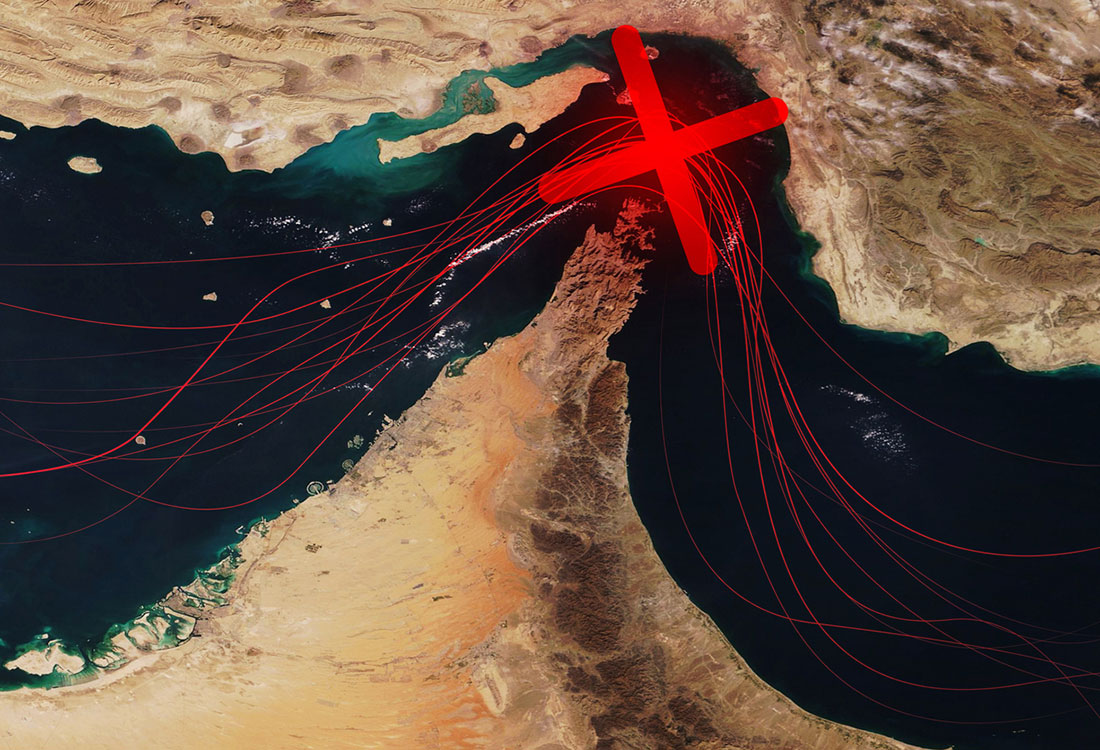
The Strait of Hormuz, the passage connecting the Persian Gulf to the Gulf of Oman, has long been recognized as the single most consequential maritime chokepoint in the global economy. Its disruption is now approaching the six-month mark, and the effects have travelled far beyond the region.
Under normal conditions, roughly 120 to 140 commercial vessels transit the strait on a typical day, with oil tankers making up the largest share, followed by container ships and bulk carriers. In the first half of 2025, total oil flows through Hormuz averaged approximately 20.9 million barrels per day, close to one-fifth of global petroleum liquids supply.
There is no practical substitute. Regional pipeline capacity can absorb only a fraction of that volume, and for Qatari and Emirati LNG there is no alternative route at all.
Ocean freight: surcharges, longer routings, absorbed capacity
The ocean freight market response was swift and measurable. Carriers implemented emergency fuel and war risk surcharges and, in several cases, introduced entirely new charge categories to recover the cost of operating in and around a designated war risk area. War risk insurance premiums climbed sharply, and some underwriters withdrew coverage for affected transits altogether, making commercial passage uneconomic regardless of a carrier’s willingness to sail.
At the same time, rerouting around the Cape of Good Hope added substantial transit time and absorbed a significant share of global fleet capacity. This second effect is the one shippers most often underestimate. A longer voyage does not simply delay a single shipment; it removes vessel capacity from the market for the duration of the additional sailing days. The result has been upward rate pressure on Asia-to-Europe and Asia-to-North America lanes, even during periods of soft underlying demand, along with clustering and congestion at transshipment hubs that were never built for the redirected traffic pattern.
Airfreight: a cost shock and a demand shift
The indirect effects on airfreight are structurally significant for two reasons: fuel costs and modal-shift demand.
Jet fuel accounts for roughly 20 to 25 percent of airline operating costs under normal conditions, so the surge in fuel prices at the peak of the disruption represented a considerable cost shock for carriers. The Gulf is not only a crude oil source, but also a major refining and jet fuel export region, which compounded the impact on markets dependent on those product flows.
On the demand side, ocean freight disruptions have historically led to a measurable shift toward air cargo for time-sensitive shipments. Shippers facing delays or rerouting on ocean lanes will in some cases absorb the higher unit cost of air freight to preserve production schedules and contractual delivery obligations. Where that shift meets constrained capacity and elevated fuel surcharges, the cost differential widens quickly.
What this means for your supply chain
The Hormuz disruption illustrates with unusual clarity how exposed modern supply chains remain to single-point geographic chokepoints. For Canadian importers and exporters, three practical implications stand out:
- Build the extra transit time into planning. Cape routings are not a temporary detour at this stage. Safety stock and reorder points should reflect the longer lead time rather than the pre-crisis schedule.
- Read your surcharge exposure carefully. War risk and emergency conflict surcharges are added to base rates and can change with limited notice. Understand which of your lanes and bookings are in scope.
- Confirm your cargo insurance actually responds. Standard marine policies routinely exclude war, terrorism, and political violence. Coverage assumptions made in a calm market may no longer hold.
Looking ahead
Volatility is likely to persist until a durable ceasefire is reached, a longer-term agreement is in place, and shipping conditions stabilize. In the meantime, businesses will need to monitor geopolitical developments closely and adapt their sourcing, logistics, and risk management strategies accordingly.
If you would like to review how your ocean and air routings are exposed to Gulf conditions, our freight team is happy to walk through the alternatives with you. A SMART Freight Review is a straightforward place to start. Contact David Lychek, Director – Ocean and Air Services.