









As trade diversification becomes a national priority, Canada’s ports are moving to the front of the infrastructure agenda. Efficient, modern maritime gateways are essential if Canadian businesses are to reach more markets, move cargo reliably and build supply chains that are less dependent on any one trade corridor.
Canada’s ports already handle substantial volumes of trade. In 2025, the Port of Montreal handled 34.3 million tonnes of cargo, while the Port of Halifax handled 8.6 million tonnes.
Their role in connecting Canadian businesses with overseas markets highlights the importance of dependable maritime gateways.
Those figures underline why port capacity is increasingly being viewed as a trade and logistics issue, not simply a marine infrastructure issue. For shippers, carriers, railways, warehouses and freight forwarders, the ability to move goods through reliable port gateways can determine whether a diversification strategy translates into real commercial capacity.
Ports Offer Different Gateways to Global Markets
Canada’s major ports serve different trade patterns, and that geographic range is a core strength. West coast ports connect Canadian exporters and importers to Asian markets. The Port of Montreal is a central hub for trans-Atlantic trade and maintains relatively comparable import and export volumes, an indicator of stable and diversified activity. Halifax provides an Atlantic gateway for containerized goods, bulk commodities and project cargo.
Halifax also has a natural deep-water advantage, with facilities capable of accommodating large container vessels. That capability matters as shipping lines deploy larger ships and look for ports that can support efficient calls, reliable connections and room for cargo growth.
A broader mix of gateways can help supply chains absorb disruption. When capacity is constrained on one coast or in a single international corridor, shippers have more options if alternative ports, inland connections, and distribution networks are ready to support the shift.
Modernization Moves Up the Project List
The federal government is preparing to invest in major port expansions as part of its effort to fast-track nation-building infrastructure projects. Port projects are attracting attention because they connect local infrastructure investment to a broader policy goal: providing Canadian producers and importers with more practical routes to global markets.
The Contrecoeur Container Terminal Project at the Port of Montreal was among the first projects referred to the federal government’s Major Projects Office. The project is expected to expand the port’s container-handling capacity by roughly 60% and generate about $140 million a year in economic benefits once operational. In-water construction began in August 2026.
On the west coast, the Roberts Bank Terminal 2 project would add 2.4 million twenty-foot equivalent units (TEUs) of annual container capacity at Roberts Bank. The federal government has announced $10 billion in support for major infrastructure upgrades to expand capacity at Roberts Bank. The project is part of the broader strategy to improve access to Asian markets and diversify export opportunities.
In Halifax, planning for future terminal capacity reflects the growing importance of Atlantic gateways in a trade network serving Europe, the United Kingdom and other overseas markets.
The Logistics Network Extends Beyond the Dock
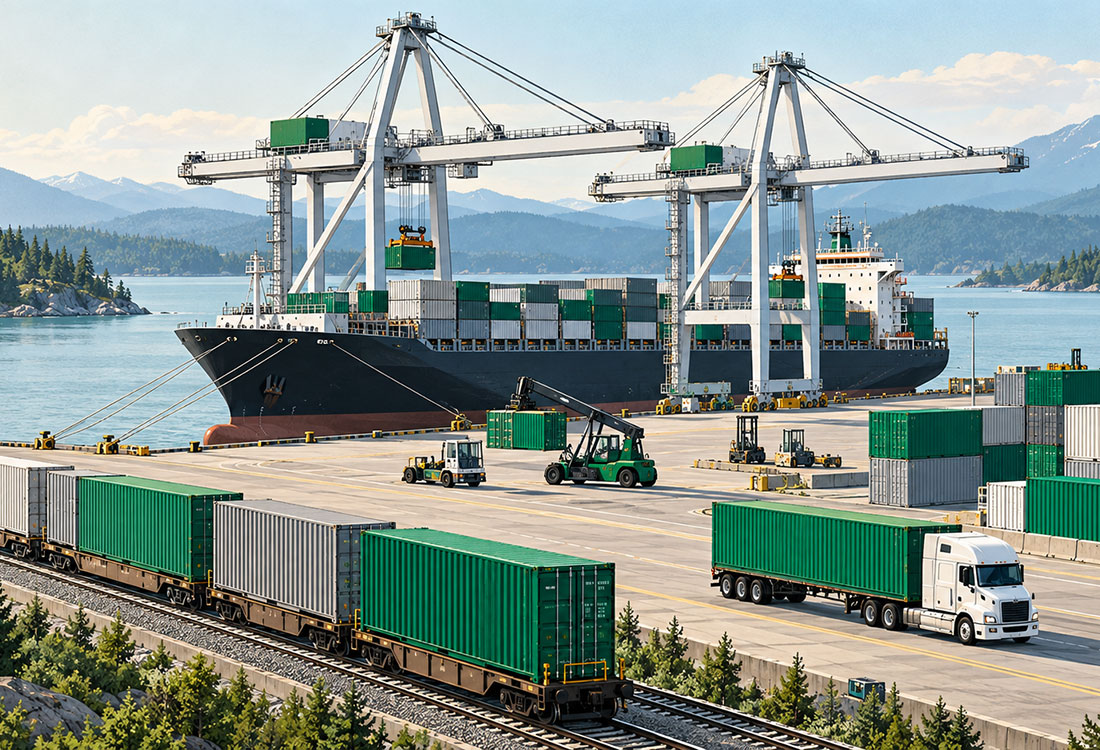
Port expansion alone will not deliver the full benefits of trade diversification. Maritime capacity has to connect with dependable rail service, truck capacity, inland terminals, warehouses and border processes. A larger terminal creates value only when cargo can flow to and from it without creating a bottleneck elsewhere in the network.
For trucking companies, growth at Canadian ports can create new opportunities in drayage, regional distribution, transload operations and inland container movements. It can also create new planning demands. Container pickup windows, terminal dwell time, chassis availability and rail handoffs all affect whether additional cargo becomes productive freight or costly delay.
Shippers will need to look beyond a single ocean leg when evaluating port options. Total landed cost, service frequency, inland transit time, storage capacity and the availability of return loads will all shape the economics of using a new gateway. The most resilient routes will be those supported by coordinated marine, rail and truck capacity.
Building Capacity for a More Resilient Trade Strategy
Diversifying trade is not a short-term rerouting exercise. It requires the physical capacity and operating discipline to move more goods through more gateways over time. Canada’s port investments are therefore part of a larger supply-chain strategy: reducing concentration risk, supporting exporters and giving importers more flexibility when global conditions change.
The near-term test will be execution. Major projects need timely approvals, reliable funding and close coordination with the transportation networks that serve them. If expansion plans are delivered alongside stronger inland connections, Canadian ports can help turn trade diversification from a policy goal into a practical advantage for the freight sector.
For the logistics industry, that would mean more than additional terminal capacity. It would create a wider set of routes, markets and service options to support Canadian trade in a more volatile global environment.
For more information, contact David Lychek, Director – Ocean & Air Services.